Keyword clustering tool: turn keywords into a page plan
How keyword clustering works (SERP overlap vs semantic grouping), how to turn a keyword list into page groups, and which tools do it at what cost in 2026.
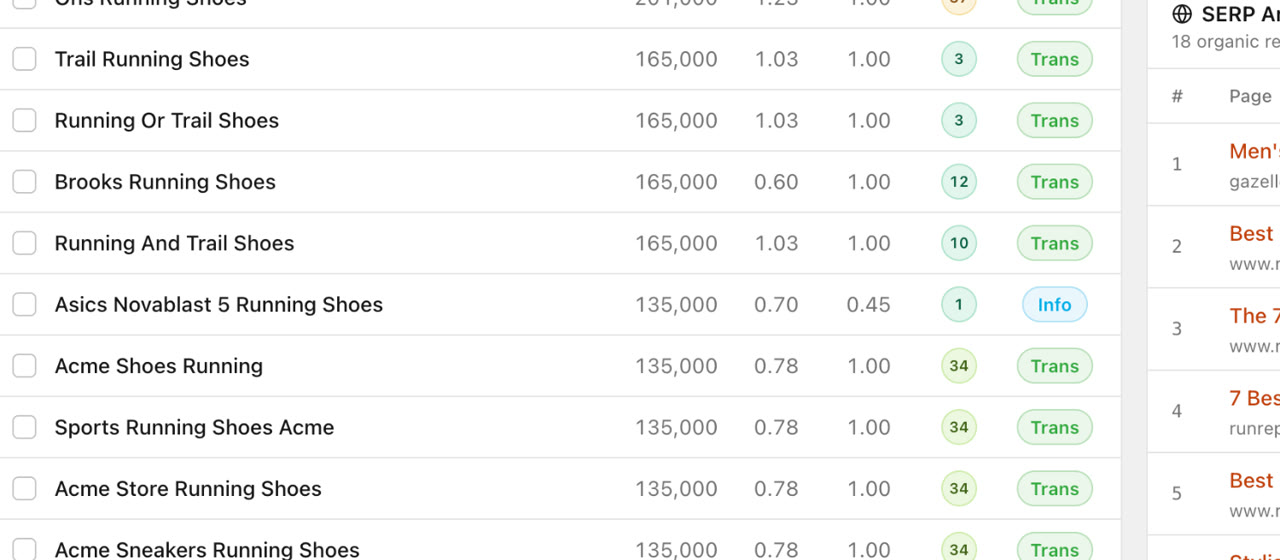
You have a keyword export with 600 rows. Some of the terms mean the same thing, some only look like they do, and a few belong to a different business entirely. Writing one page per keyword would give you 600 thin pages that compete with each other. Sorting them by hand would take a week.
That is the job of a keyword clustering tool: decide which keywords one page can rank for together, and which need their own page. Done well, the output is not a list of groups but a content map you can build from.
This guide explains the two main ways clustering works, a step-by-step process for turning a list into page groups, what the common tools cost as of October 2026, and how to run the same workflow with an AI agent and real search data in SEO Sauna.
What keyword clustering actually decides
Keyword clustering groups search terms that share the same intent, so one page can target the whole group. The real question behind every cluster is simple: would Google show the same pages for these searches?
If yes, the keywords belong on one page. If Google shows different pages, a single page will usually struggle to rank for both, no matter how well it is written.
Getting this right prevents two expensive mistakes:
- Cannibalization: two of your pages target the same intent and split clicks, links and rankings between them.
- Intent mismatch: a blog post targets a keyword where Google only shows product pages, or the other way round.
SERP overlap vs semantic clustering
There are two basic methods, and most tools use one, the other or a mix.
| SERP-overlap clustering | Semantic clustering | |
|---|---|---|
| How it groups | Compares the top 10 Google results for each keyword; keywords that share enough ranking URLs go together | Groups keywords by meaning, using shared words or language models |
| What it captures | How Google actually treats the queries today | How the words relate to each other |
| Strength | Reflects real intent, catches "looks different, means the same" | Cheap and fast, works without live search data |
| Weakness | Costs a SERP lookup per keyword, results shift over time | Misses intent splits, "looks the same, means different" |
| Best for | Final page mapping, borderline terms | First pass on a very large list |
A classic example of where semantic grouping fails: "crm" and "crm software" look like the same topic, but the results for "crm" often lean toward definitions while "crm software" shows product lists and comparisons. Meanwhile "invoice template" and "invoice sample" look different but often share most of their top results.
SERP-overlap tools usually let you set a threshold: how many shared URLs in the top 10 count as "the same intent". Around three or four shared URLs is a common starting point. A higher threshold gives tighter, smaller groups; a lower one merges more aggressively.
The practical approach is to use both. Let meaning do the cheap first sort, then check the SERPs for the terms that decide your page structure.
How to turn a keyword list into page groups
This process works whether you use a dedicated tool, a spreadsheet or an AI agent.
1. Start from a clean, relevant list
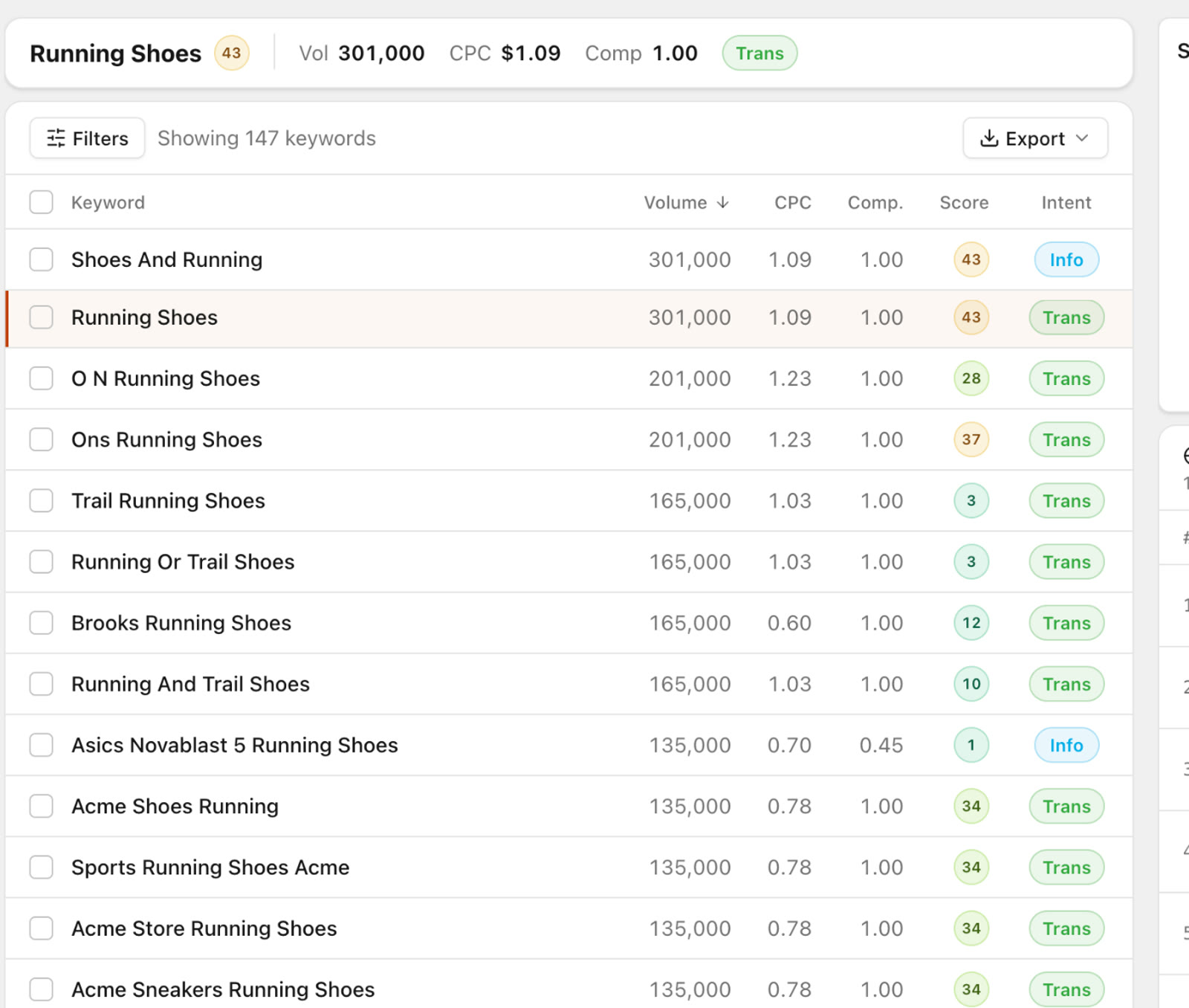
Combine your sources: keyword research exports, competitor ranking keywords and, most valuable of all, your own Search Console queries. Then remove duplicates, misspelling variants you will not target separately, and terms for products or audiences you do not serve. Clustering junk only produces organised junk.
2. Do a first rough sort by topic
Group obvious relatives by meaning: everything about "descaling", everything about "pricing", everything about "best X for Y". This does not decide pages yet. It just makes the next step manageable.
3. Check the SERPs for the decisions that matter
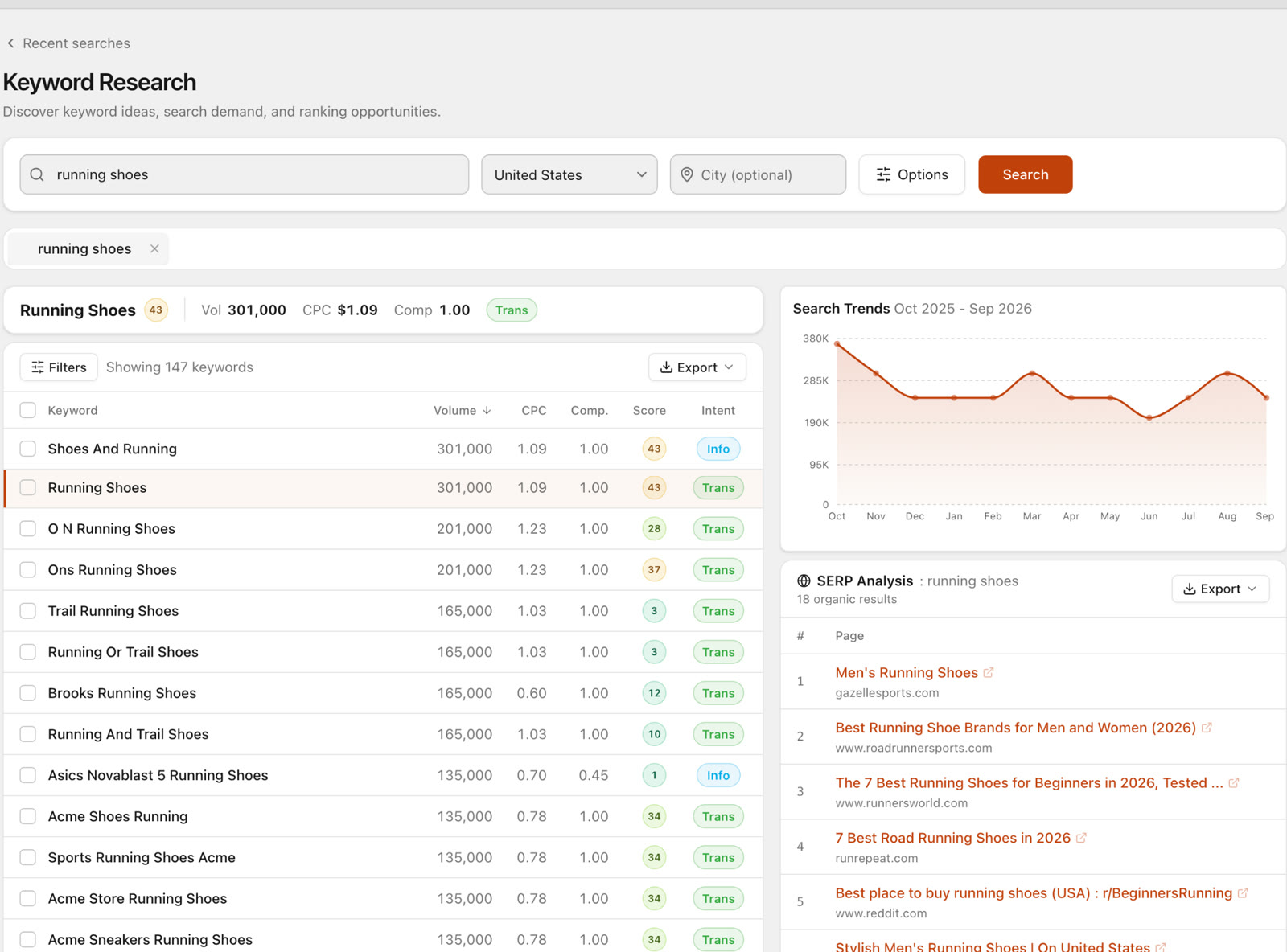
Inside each rough group, compare the top results for the main terms. Ask:
- Do the same URLs rank for both keywords?
- Is the result type the same (guides, product pages, category pages, tools, videos)?
- Is the buyer stage the same (learning, comparing, ready to buy)?
You do not need a SERP check for every long-tail variant. You need one for every pair where splitting or merging would change your site structure.
4. Pick a primary keyword per cluster
Usually the term with the highest volume that still matches the cluster's intent exactly. The rest become secondary keywords that the page covers in headings, sections and FAQs.
5. Map each cluster to a URL
Every cluster gets one of three outcomes: an existing page to update, a new page to create, or a "not now" bucket for weak or off-strategy terms. If two existing pages fit the same cluster, that is a cannibalization question: keep one, merge or redirect the other.
6. Prioritise
Rank clusters by business value, realistic difficulty and how close you already are. A cluster where you rank on page two in Search Console is usually a faster win than one where you have nothing.
Keyword clustering tools compared
Prices below are taken from the vendors' own pricing pages in October 2026. Some pages showed euro prices from our location in Finland, so those are given in euros.
| Tool | Clustering method | Pricing (as of October 2026) |
|---|---|---|
| Keyword Insights | SERP-based clustering plus intent classification | From about $58/month (10,000 credits, 1 credit per keyword clustered); $1 seven-day trial |
| SE Ranking Keyword Grouper | Groups by matching URLs, with a configurable minimum of shared URLs | Plans from about €87/month; the grouper is part of the suite |
| Ahrefs Keywords Explorer | "Keyword clusters" feature inside Keywords Explorer | Listed on Standard plan and up, from about €229/month; Lite (about €119/month) does not list it |
| Semrush Keyword Strategy Builder | Sorts keywords into topics, pillar pages and subpages | Part of Semrush's SEO plans, from about €134/month billed monthly |
| SEO Sauna Keyword Clustering skill | AI agent groups by intent, checks SERP overlap for borderline terms, maps to your pages | €59/month excl. VAT including 17,000 credits; free start with 1,000 trial credits |
What the big suites do better: Ahrefs and Semrush have large keyword databases, long history and polished clustering interfaces. Keyword Insights is built specifically for clustering at scale and processes thousands of keywords in one run. If your main job is clustering 20,000-keyword exports every week, a dedicated tool is the most efficient choice.
Where an agent workflow fits better is the part after grouping: deciding which existing page each cluster belongs to, spotting cannibalization in your own data and writing the page briefs.
How SEO Sauna's Keyword Clustering skill works
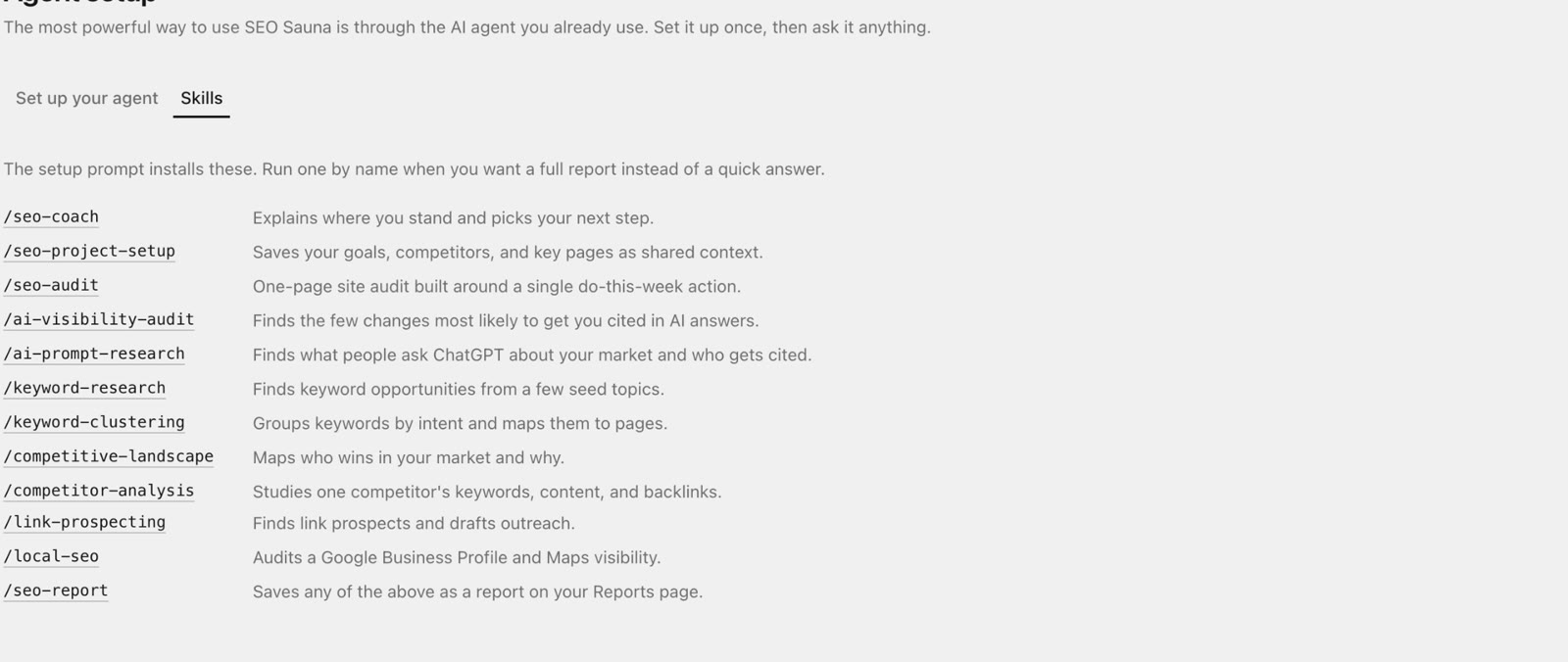
SEO Sauna exposes its data to AI assistants such as Claude, ChatGPT, Cursor and Codex through an MCP server. The Keyword Clustering skill is a step-by-step method the agent follows on top of that data. It is a keyword mapping workflow, not just a grouping exercise.
What it uses
- Your keywords: a pasted list, saved keywords in SEO Sauna (optionally filtered by tag), a seed topic it expands with keyword research, or the keywords a domain already ranks for.
- Search Console: when connected, the agent pulls real queries together with the pages that earn impressions for them. That shows which page already "owns" a query and where one query splits impressions across several URLs. Search Console reads use no credits.
- Live SERPs: for important borderline terms, the agent checks the current Google results in small batches to confirm whether two keywords belong on the same page. Local SERPs are used when map-pack intent matters.
- Project context: your saved business description, goals and key pages. The key pages are what clusters get mapped to. If none are saved, the skill asks you for them first.
The rules it follows
- SERP intent wins over word similarity. Similar words do not guarantee the same cluster.
- Small lists stay simple. With fewer than 10 usable terms it produces a simple map instead of forcing clusters.
- Target pages are labelled "proposed" when you have not supplied URL data.
- Tags change only with your approval. It suggests saved keyword tags per cluster and asks before applying them.
- No repeat purchases. It checks the project's research log and reuses research done in the last 30 days instead of buying the same data again.
What you get back
A report saved to your SEO Sauna project with: a one-line summary of the map (clusters, pages to create, pages to update, cannibalization found), a cluster table with primary keyword, intent, target page and priority, a short brief per cluster, a cannibalization table when there is real evidence, and a numbered list of next steps.
Example walkthrough
Say you run an online shop for home espresso equipment and have 40 keywords from research and Search Console. You connect SEO Sauna to Claude and ask:
Cluster my saved keywords tagged "espresso" and map them to my key pages. Check SERP overlap for anything borderline. Use Search Console to look for cannibalization.
The agent loads your project context and the saved keywords, pulls Search Console queries by page, and runs SERP checks on a handful of borderline pairs. A simplified version of the result (example data):
| Cluster | Primary keyword | Intent | Target page | Priority |
|---|---|---|---|---|
| Beginner machines | espresso machine for beginners | Commercial, comparing | /guides/beginner-espresso-machines (new) | High |
| Budget machines | best espresso machine under 500 | Commercial, comparing | /guides/beginner-espresso-machines (merge) | High |
| Descaling | how to descale an espresso machine | Informational | /blog/descaling (update) | Medium |
| Grinders | burr grinder for espresso | Commercial | /category/grinders (update) | Medium |
| Latte art | latte art for beginners | Informational | Later | Low |
Two details are where the work pays off. The SERP check showed that "espresso machine for beginners" and "best espresso machine under 500" share most of their top results, so they go on one page, even though a word-based tool split them. And Search Console showed the query "descale espresso machine" sending impressions to both a blog post and a product page for descaler, so the report flags it as cannibalization and recommends which page should own the query.
You then review the map, ask the agent to tag the saved keywords by cluster, and use the page briefs to write or update the pages.
Tips for better clusters
- Name the market. SERPs differ by country and language. Cluster US keywords on US results.
- Do not cluster forever. Clusters are a planning tool. Re-check the SERPs for important terms every few months, not every week.
- Trust your own data first. Search Console shows which of your pages Google already associates with a query. That beats any third-party guess.
- Keep judgment in the loop. A cluster can be technically correct and still not be worth a page for your business.
If you already use an AI assistant for SEO, the Claude SEO guide covers the setup, and Search Console MCP explains how the agent reads your own query data. For a product overview, see SEO Sauna 101.
FAQ
What is a keyword clustering tool?
A keyword clustering tool groups search terms that share the same search intent, so you can target each group with one page. Most tools compare the Google results for each keyword, group them by meaning, or combine both methods.
Is SERP-based clustering better than semantic clustering?
For final page decisions, usually yes, because it shows how Google treats the queries today. Semantic grouping is cheaper and useful for a quick first sort of a very large list. A good workflow uses meaning first and SERP checks for the borderline terms.
How many keywords should one cluster have?
There is no fixed number. A cluster can be two keywords or thirty, as long as they share intent and the same pages rank for them. If a cluster grows huge, check whether it really contains two different intents.
Can ChatGPT or Claude cluster keywords on their own?
They can group keywords by meaning, but without live data they cannot see which pages rank for each term or what your Search Console shows. Connecting a data source through MCP lets them check SERPs and your own queries while they cluster.
How much does clustering cost in SEO Sauna?
There is no separate charge for the skill. SERP checks and keyword research use credits from the €59/month plan, which includes 17,000 credits each month, while Search Console reads and saved reports use none. New accounts get 1,000 trial credits without a card.
More from the blog
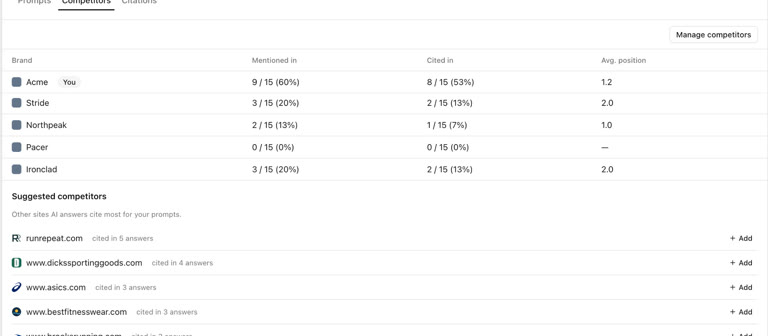 AI discoverability audit: how to run an AI visibility audit
An AI discoverability audit shows whether ChatGPT, Gemini and Google AI name and cite your brand, and why not. Steps, prompts and what to fix first.
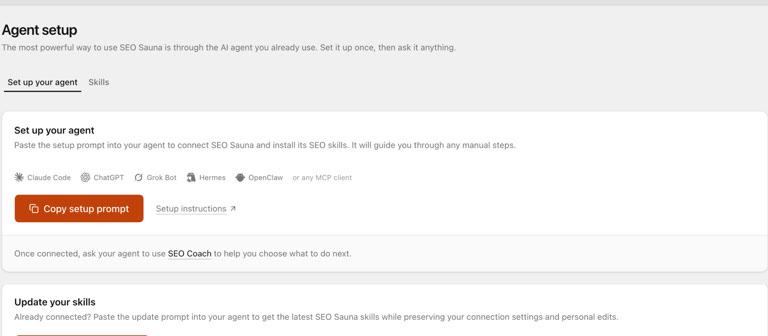 ChatGPT MCP server for SEO: connect live SEO data
Connect an SEO MCP server to ChatGPT as a custom connection on Free or paid plans: step-by-step setup, error fixes and SEO prompts with real keyword data.