How to track brand mentions in ChatGPT and other AI answers
Track brand mentions in ChatGPT and Gemini: see whether AI answers name your brand, which competitors they recommend instead and which pages they cite.
A growing share of buying research no longer starts with a Google search. It starts with a question to ChatGPT, Gemini or Google's AI Overviews: "what is the best project management tool for a small agency?", "which running shoes are good for flat feet?", "who does SEO audits in Helsinki?"
The answer is a short paragraph with three to five names in it. If your brand is one of them, you are on the shortlist before the buyer has visited a single website. If it is not, you may never find out why traffic from that audience is drying up.
This guide covers how to check whether AI assistants mention you, how to track it over time instead of checking by hand and what to do with what you find.
Why checking by hand does not work
The obvious first step is to open ChatGPT and ask. It is worth doing once, but it tells you very little:
- Answers vary. Ask the same question twice and the list of brands can change. One answer is an anecdote, not a measurement.
- Your account is not your customer's. Personalisation, memory, location and language all shape what you see.
- One engine is not the market. ChatGPT, Gemini and Google AI Overviews often recommend different brands for the same question.
- Nothing is saved. Without a record, you cannot tell whether a change on your site made any difference.
Useful tracking means asking the same exact questions, in the same market, on a schedule, across more than one engine, and keeping every answer.
What to measure
Three things are worth tracking for each question:
- Mentions: does the answer name your brand or your domain?
- Citations: does the answer link to your website as a source? A mention without a citation means the model knows you; a citation means it trusts a specific page of yours enough to point to it.
- Competitors: which other brands appear, and how often, compared with you.
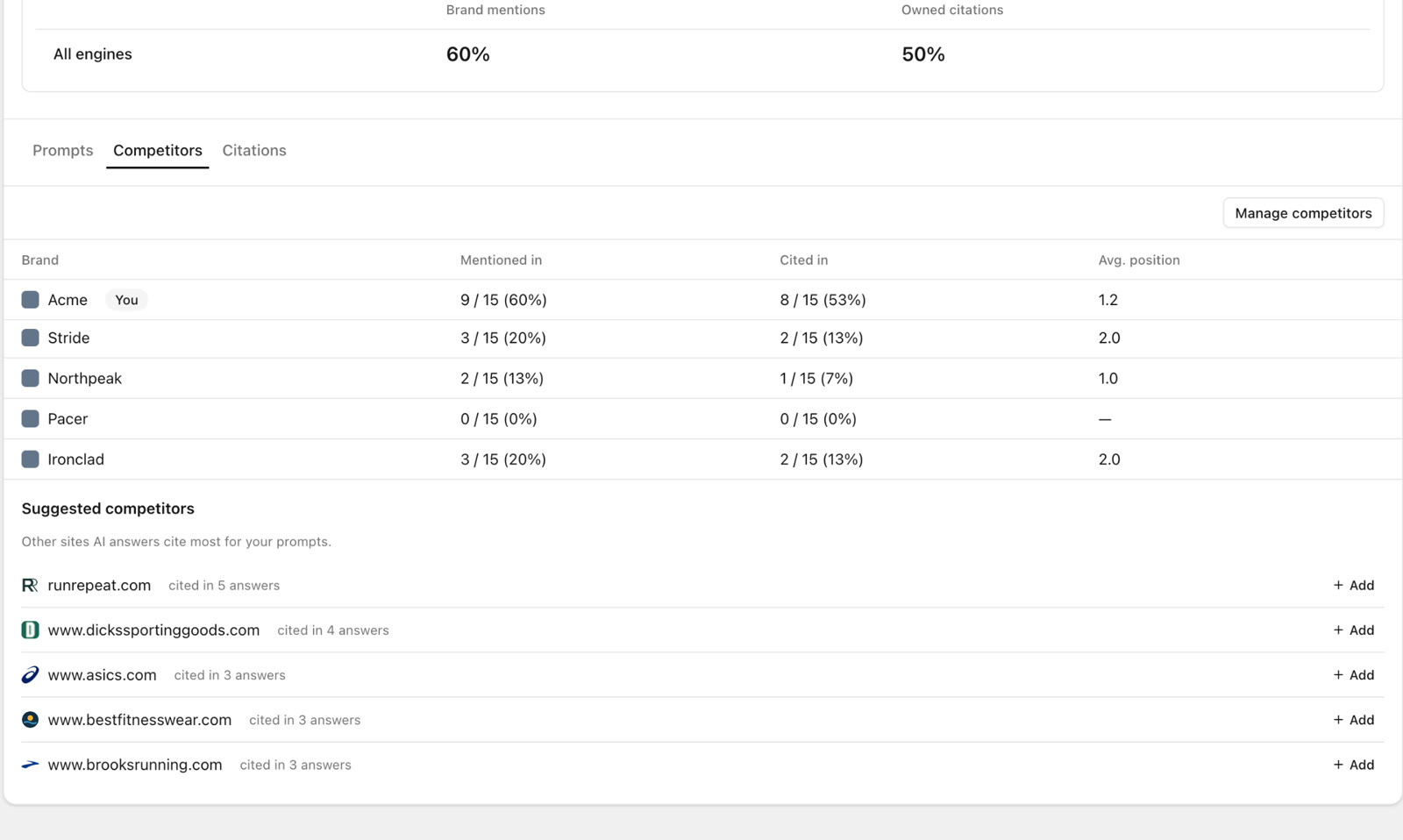
Over time you also want the trend: are you appearing in more answers this month than last month, and on which engines?
Step 1: Choose the right questions
Tracking the wrong questions is the most common mistake. "Best CRM" is too broad for most companies and will be dominated by the largest brands. The questions that matter are the ones your actual buyers ask, at the moment they are choosing.
Good tracking questions are:
- Specific to a use case: "best CRM for a five-person consultancy" rather than "best CRM".
- Comparison and recommendation questions: "X vs Y", "alternatives to X", "which tool should I use for…".
- Problem-first questions your product solves: "how do I stop clients missing appointments?"
SEO Sauna's Prompt Research helps here. Give it a keyword and it finds the questions people ask about that topic, together with ChatGPT's answers and the sources they cite. The questions come mostly from Google's "People also ask" data. They are real questions people search for, not logged ChatGPT prompts, and SEO Sauna does not invent an "AI search volume" for them, because nobody can measure that reliably. Research currently covers US English and costs about €0.25 in credits per keyword.
Step 2: Try a question across engines
Before you commit a question to tracking, look at how different models answer it. Prompt Explorer runs one prompt in ChatGPT by default and can add Claude, Gemini and Perplexity side by side, with the citations each provides.
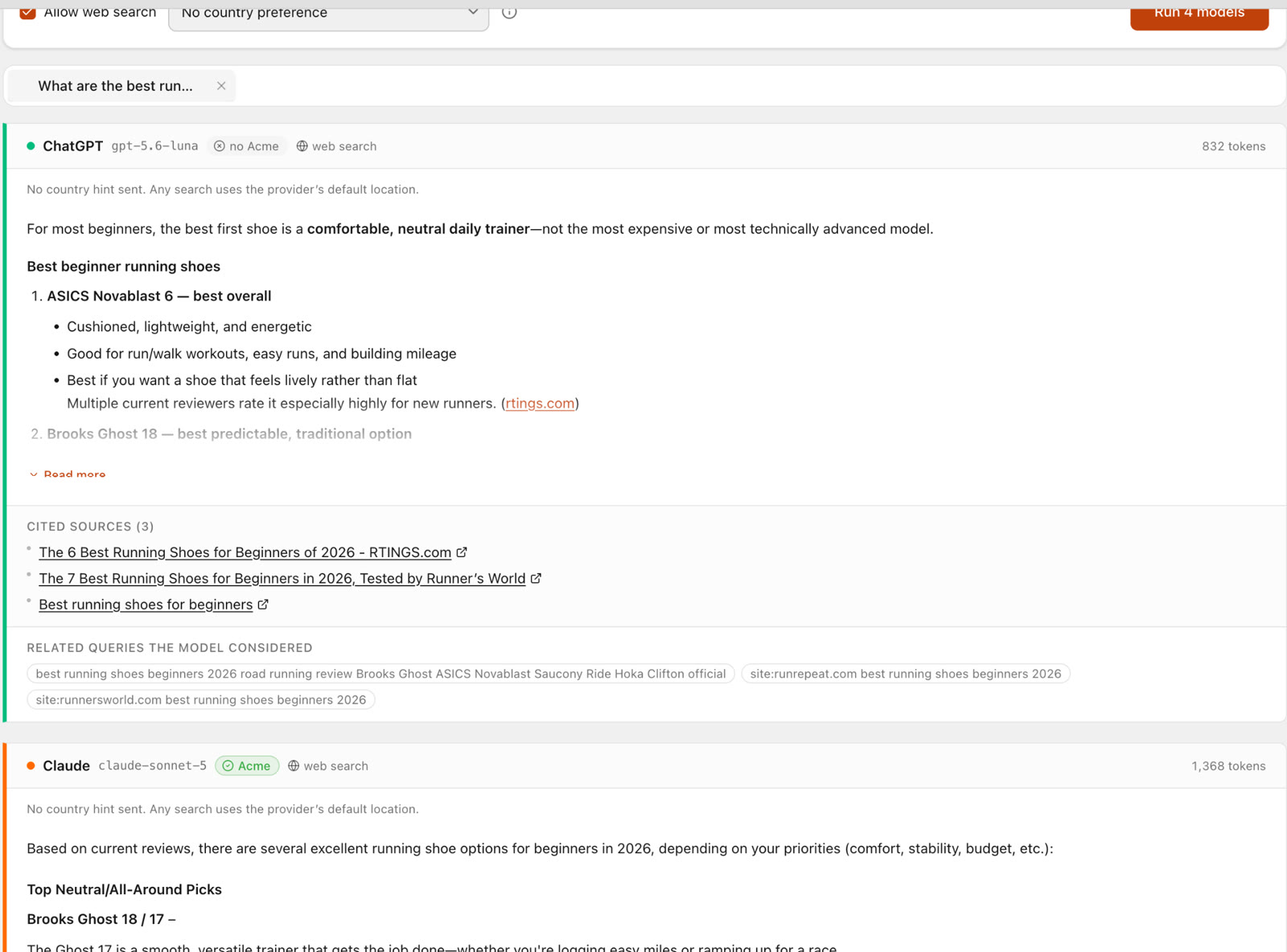
This is a quick way to see whether a question is worth tracking at all. If every engine gives a generic answer with no brands in it, pick a more specific question. If every engine names the same three competitors, you have found a question worth winning.
Prompt Explorer uses the models' APIs, so its answers can differ from what people see on the consumer sites. That is why tracking collects answers differently.
Step 3: Track it on a schedule
Prompt Tracking is where measurement happens:
- Save the exact questions under topics, for example "pricing", "alternatives" or "local".
- Choose the engines. ChatGPT and Gemini are on by default; Google AI Overviews, Claude and Perplexity are also available.
- Choose the market, and how often to check: daily, weekly or monthly.
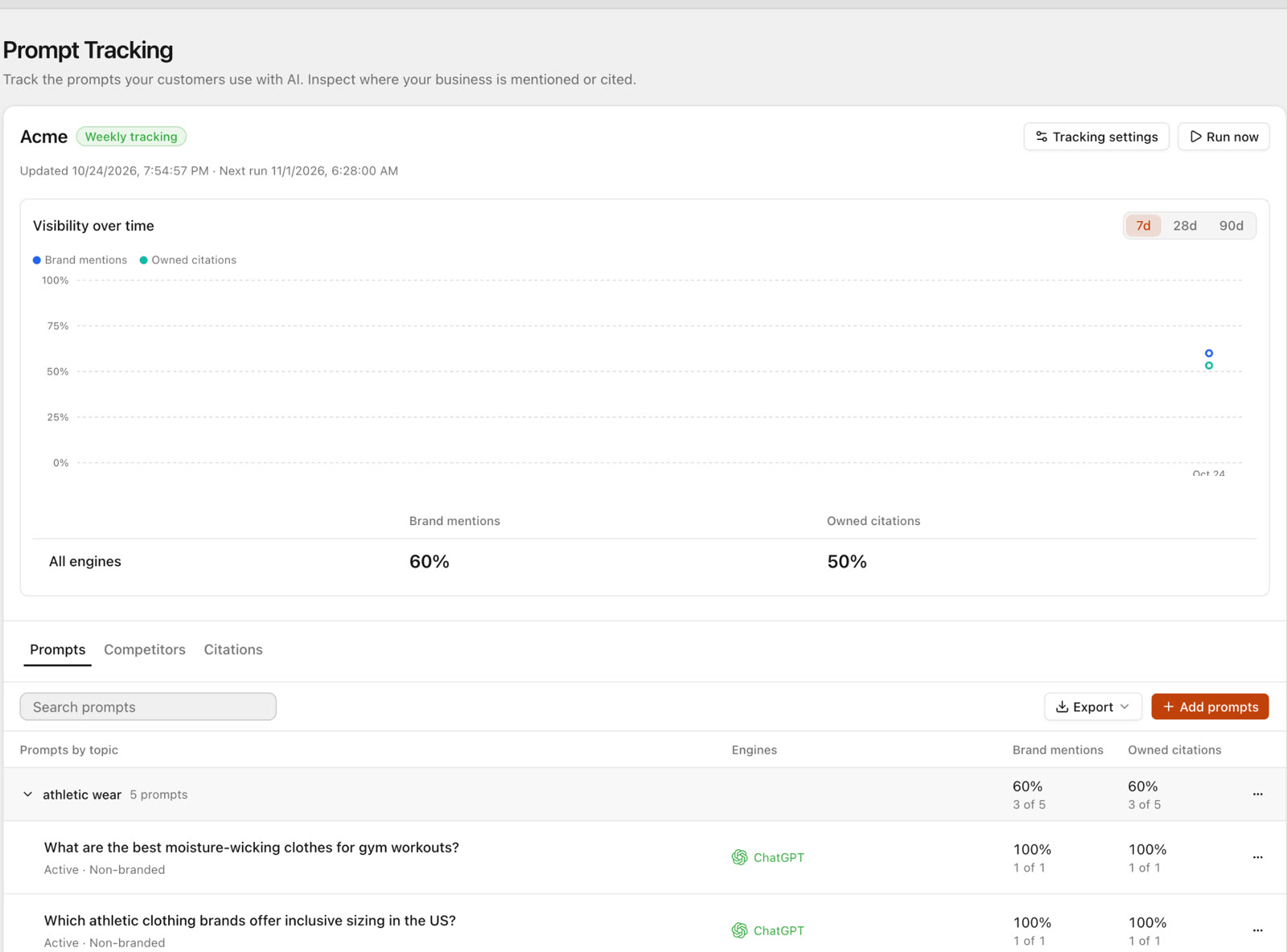
ChatGPT and Gemini answers are collected from their consumer sites, which is closer to what your customers see than an API call. Before anything runs, SEO Sauna shows a cost estimate, and each check is billed as it collects answers. Prompt tracking works with trial credits too, so you can try it before subscribing.
Two details make the data trustworthy:
- Editing a question creates a new question. Earlier answers keep the wording they were collected with, so trends never mix two different prompts.
- A failed check is not counted as absence. If an engine does not answer, that run is not treated as "your brand was not mentioned".
Step 4: Read the results
Once checks have run, three views answer the questions that matter:
- Trend: how often your brand appears across checks over time, using the latest finished run per day.
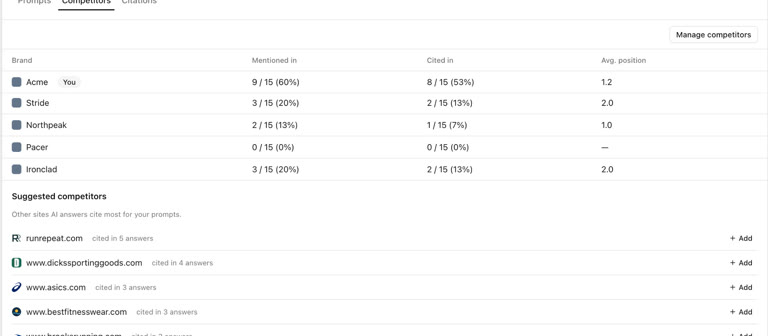
- Competitors: which competitors from your project appear, and how their share compares with yours.
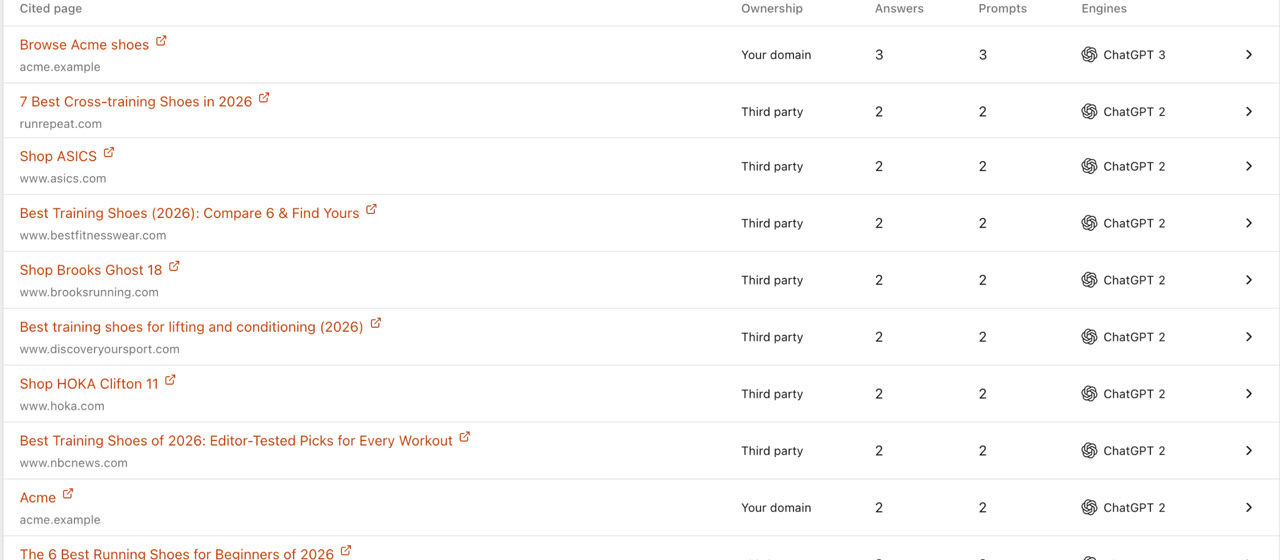
- Citations: which pages the answers cite, yours and everyone else's.
The citations view is usually the most actionable. If AI answers in your market keep citing the same comparison article, review site or competitor guide, that page is shaping the recommendation. You can study it, earn a mention on it or publish something more useful.
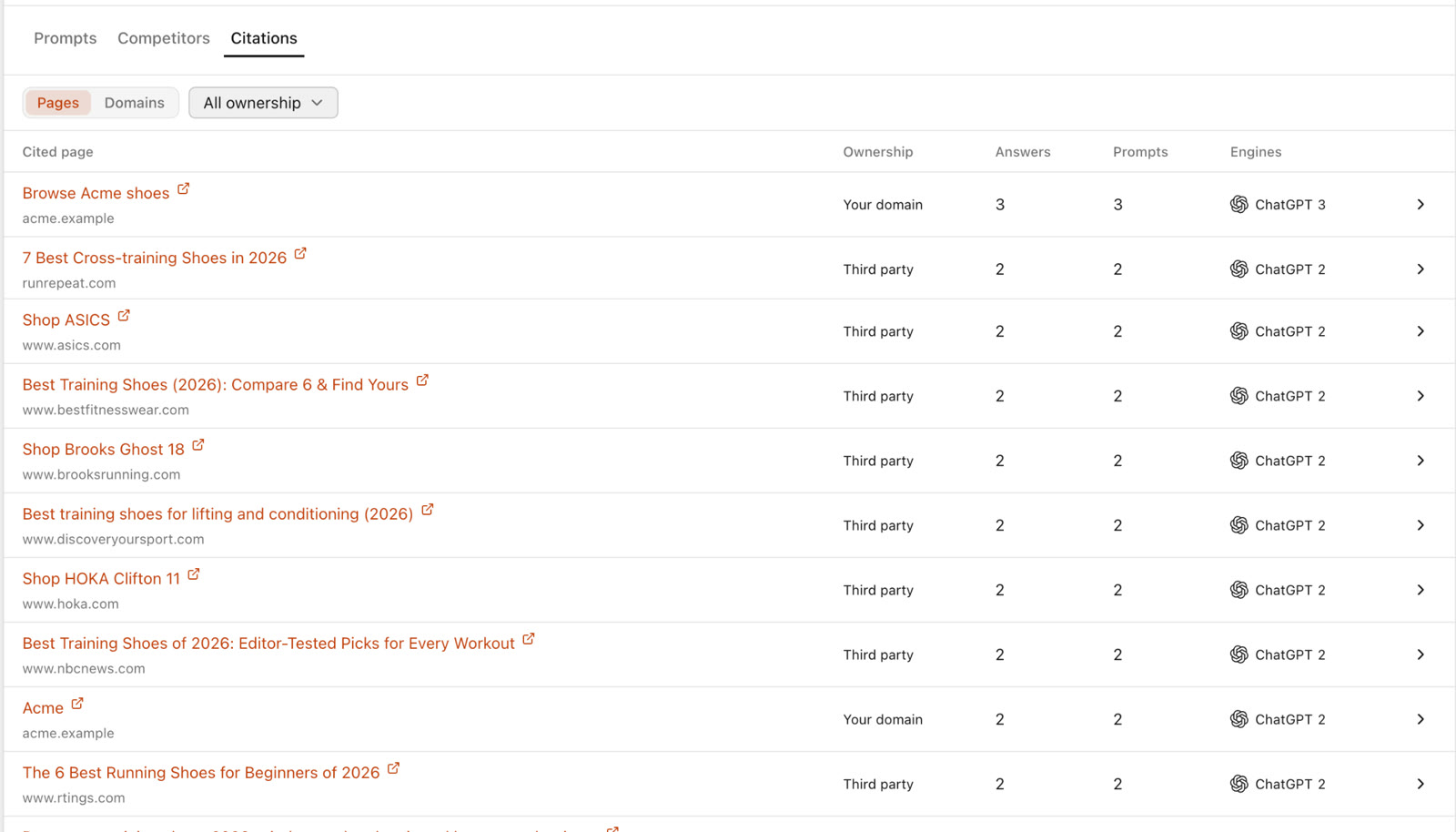
Viewing and exporting saved results uses no credits.
Step 5: Do something with it
Tracking only pays off if it changes what you do. Patterns we see often:
- You are mentioned but never cited. Models know your brand but do not see a page of yours as the best source. Publish a clear, specific page that answers the question directly, with facts a model can quote.
- A competitor is cited from one page. Look at that page. It is often a well-structured comparison, a pricing explanation or an honest "who this is for" section that you do not have.
- Third-party pages dominate citations. Lists, reviews and community threads carry weight. Getting included there is closer to digital PR than to on-page SEO.
- You appear on one engine but not another. Engines rely on different sources. Check which pages the stronger engine cites and whether the weaker one can reach similar content about you.
Then keep the tracking running and watch whether the changes move the numbers.
Do it from your AI assistant
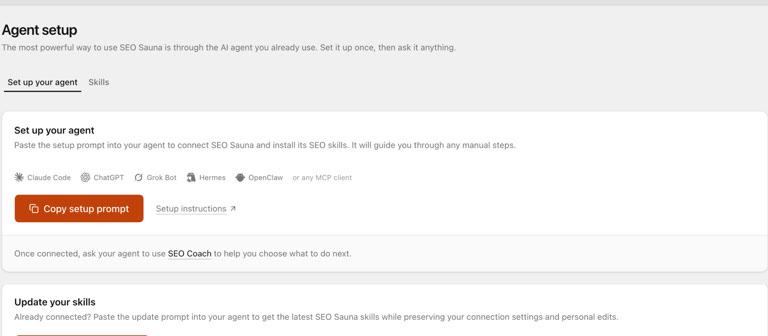
Everything above also works through SEO Sauna's MCP server, so you can run it from Claude, ChatGPT or Cursor:
Research the questions people ask about "[your category]", pick the ten most relevant to [your audience] and set up weekly tracking on ChatGPT and Gemini in the US. Show me the cost estimate first.
Look at the last month of tracked answers. Which competitors appear more often than us, and which cited pages explain why?
The AI Visibility Audit skill turns the second request into a repeatable workflow that ends in a list of concrete improvements. See AI Visibility for engines, coverage and costs in detail. For the full method, from choosing prompts to fixing what AI cites, follow the AI discoverability audit guide, and see how ChatGPT rank tracking and AI Overview tracking fit in. The AI visibility overview sums up what SEO Sauna covers.
FAQ
Can I see how many people ask ChatGPT a specific question?
No one can measure that reliably, so SEO Sauna does not show an "AI search volume". Prompt Research finds real questions people search for on Google, which is a sound proxy for what they also ask AI assistants.
Which AI engines can I track?
ChatGPT and Gemini by default, plus Google AI Overviews, Claude and Perplexity.
How often should I track?
Weekly is a good default for most brands. Daily makes sense around launches or campaigns, monthly for a broad, slow-moving set of questions.
Does it work with the free trial?
Prompt Tracking needs only credits, so the 1,000 trial credits you get at signup are enough to try it. Prompt Research and Prompt Explorer need the paid plan.
What counts as a mention?
Your brand counts as mentioned when its name or domain appears in the answer, and as cited when the answer links to your website.
More from the blog
 AI discoverability audit: how to run an AI visibility audit
An AI discoverability audit shows whether ChatGPT, Gemini and Google AI name and cite your brand, and why not. Steps, prompts and what to fix first.
 ChatGPT MCP server for SEO: connect live SEO data
Connect an SEO MCP server to ChatGPT as a custom connection on Free or paid plans: step-by-step setup, error fixes and SEO prompts with real keyword data.